
Glimpses of the Invisible
Visualising the Principles of Nature Before the Rise of Modernity
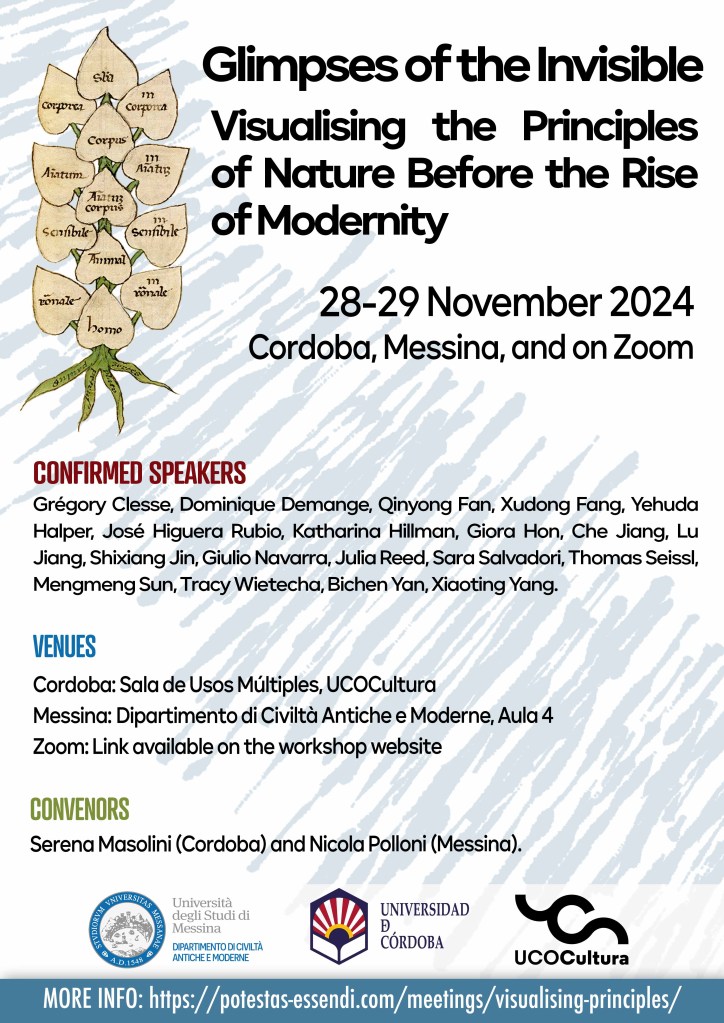
Workshop (hybrid), Cordoba (ES) and Messina (IT), 28-29 November 2024. YouTube Teaser
In their historical course, philosophy and science have sought to understand the intrinsic functioning of the natural world. However, beneath the observable physical objects, these disciplines often envisioned a rich structure of unperceivable entities that were believed to constitute what we see in our world as either principles or basic constituents. This population encompasses series of physical objects too small to be seen (such as elements, atoms, and corpuscles), real entities lacking physicality (such as those maintained by late scholastic hylomorphism), onto-cosmological principles (such as 氣/qi, 理/li, and 太極/taiji in Chinese philosophy), as well as imaginary and abstracted objects of different kinds. The workshop Glimpses of the Invisible: Visualising the Principles of Nature Before the Rise of Modernity aims to explore how premodern philosophers and scientists engaged with the visual representation of these principles and entities, as well as their interactions.
These objects, being unperceivable, necessitated processes of abstraction (and sometimes, analogical transfer) from the manifold instances of physical bodies in which they reveal themselves. At times, this process resulted in the creation of explanatory diagrams, such as Zhou Dunyi’s 太極圖, whose impact transcended their initial clarificatory function to become self-standing theoretical devices. On other occasions, charts and schemes employed to elucidate the interconnections among abstract entities at times resulted in a reification of the entities they sought to clarify, as exemplified by the varied reception of Porphyry’s tree. Beyond abstraction, the study of how physical entities behave prompted the position of imaginary objects whose representation, as in the case of the celestial spheres, sometimes led to their ‘concretisation’ into new real entities.
Glimpses of the Invisible aims to shed light on the interconnection between theorisation and representation of the principles of nature. Whether these entities were considered as real, abstract, imaginary, or symbolic, the chosen means of representation often transcended their clarificatory function and laid the ground for new claims in ontology, natural philosophy, and science. By opening the discussion to various forms of visualisation (including diagrams, illuminations, charts, schemes, etc.) and diverse textual genres (from philosophical and religious commentaries to scientific treatises), the workshop seeks to start a global discussion on the interplay between abstract theorisation and graphic representation of natural principles in different linguistic and cultural settings. The goal is to foster a more nuanced appreciation of the impact that visualisations may have (and have had) on the theories they complement and their later interpretations.
Organisers: Serena Masolini (Universidad de Córdoba), Nicola Polloni (Università di Messina)
Scientific Committee: Qinyong Fan (Yangzhou), Jules Janssens (Leuven), Shixiang Jin (Beijing), Katja Krause (Berlin), María del Carmen Molina Barea (Córdoba), Francesca Pentassuglio (Messina), Michela Pereira (Florence)
Speakers: Grégory Clesse (Louvain-la-Neuve), Dominique Demange (Paris), Qinyong Fan (Yangzhou), Xudong Fang (Shanghai), Yehuda Halper (Tel Aviv), José Higuera Rubio (Madrid), Katharina Hillman (Bar Ilan), Giora Hon (Haifa), Che Jiang (Beijing), Lu Jiang (Guangzhou), Shixiang Jin (Beijing), Giulio Navarra (Foggia), Julia Reed (Bar Ilan), Sara Salvadori (Florence), Thomas Seissl (Fribourg), Mengmeng Sun (Beijing), Tracy Wietecha (Berlin), Bichen Yan (Beijing), Xiaoting Yang (Hangzhou)
Programme
The workshop will be conducted in a hybrid format on 28-29 November 2024, offering participants and attendees the option to either attend in person at one of the two venues (Cordoba and Messina) or join remotely via Zoom. If you plan to attend in person, you can download the guides we have created to help you plan your stay using the buttons below. Please, note that unfortunately the organisers are unable to cover any expenses.
All times are in Central European Time (CET).
28 November 2024
9.30-9.40: Serena Masolini and Nicola Polloni, Introductory words
Session 1 | Nature and the Divine
9.40-10.20: Yehuda Halper, Ecce Homo: Charting Human and Divine, Substance and Property, in Contradictory Syllogisms in a Short, Anonymous Text in Three Manuscripts
10.20-11.00: Sara Salvadori, The Poetry of Revelation: The Image of the Cosmological Instrumentum in the Visions of Hildegard von Bingen
11.00-11.30: coffee break
Session 2 | The building blocks of nature
11.30-12.10: José Higuera Rubio, Flowing Points, Wavered Lines and Twisting Surfaces: The Geometrical Embodiment of Elemental Composition
12.10-12.50: Lu Jiang, The Nature of Change – Diagram of the Four Terrestrial Elements in Qiankun Tiyi
12.50-14.30: lunch break
Session 3 | Natural constancy and epistemic paradoxes
14.30-15.10: Che Jiang and Mengmeng Sun, Temporalizing Qi: A Survey of the Diagrammatic Tradition of 72 Hou
15.10-15.50: Thomas Seissl, The Quantification of Nothingness: Philoponus on Aristotle’s PhysicsΔ.8
15.50-16.30: Bichen Yan, The Reconciliation of European and Chinese Theories of Mineral Genesis in the 17th-Century Chinese Translation of De re metallica
16.30-17.00: coffee break
Session 4 | Structuring nature
17.00-17.40: Giulio Navarra, Nature as a Principle in Kindī-Circle’s Translation of Alexander of Aphrodisias’ On Providence
29 November 2024
Session 5 | Planets, stars, and heavens
9.30-10.10: Katharina Hillmann, Abraham Bar Hiyya’s Zurat ha-Aretz and the Hebrew and Latin Adaptation of Astronomical Diagrams
10.10-10.50: Giora Hon, Kepler’s Move from Orbs to Orbits from Concrete Imagery to Abstract Conception
10.50-11.20: coffee break
Session 6 | Images, patterns, and change
11.20-12.00: Qinyong Fan, The Multiple Meanings of ‘Image-Number’ (象數) in Cao Yuanbi’s ‘Study of The Book of Changes’ (《周易學》)
12.00-12.40: Shixiang Jin, ‘Principles Embodied in Images’: The ‘Supreme Principle’ and ‘Ceaseless Circulation’ in Lai Zhide’s Diagram of Gua Qi and Solar Terms
12.40-13.20: Xudong Fang and Xiaoting Yang, A Discourse on Taiji: An Interchange on Creativity Between Eastern and Western Philosophies in the Late Ming Dynasty
13.20-14.45: lunch break
Session 7 | Organic structures
14.45-15.25: Grégory Clesse, Unperceivable Philosophical Entities through Medieval Illuminators’ Eyes: Text and Miniatures in the French Translation of the De proprietatibus rerum
15.25-16.05: Tracy Wietecha, Function and Form: Philipp Jakob Hartmann on Dissecting Unnatural Kidney Shapes and Natural Philosophy
16.05-16.45: Julia Reed, Spirited Away: The Rete Mirabile in Crooke’s Microcosmographia
16.45-17.00: Serena Masolini and Nicola Polloni, Closing words
Latest update: December 2024
 Potestas essendi