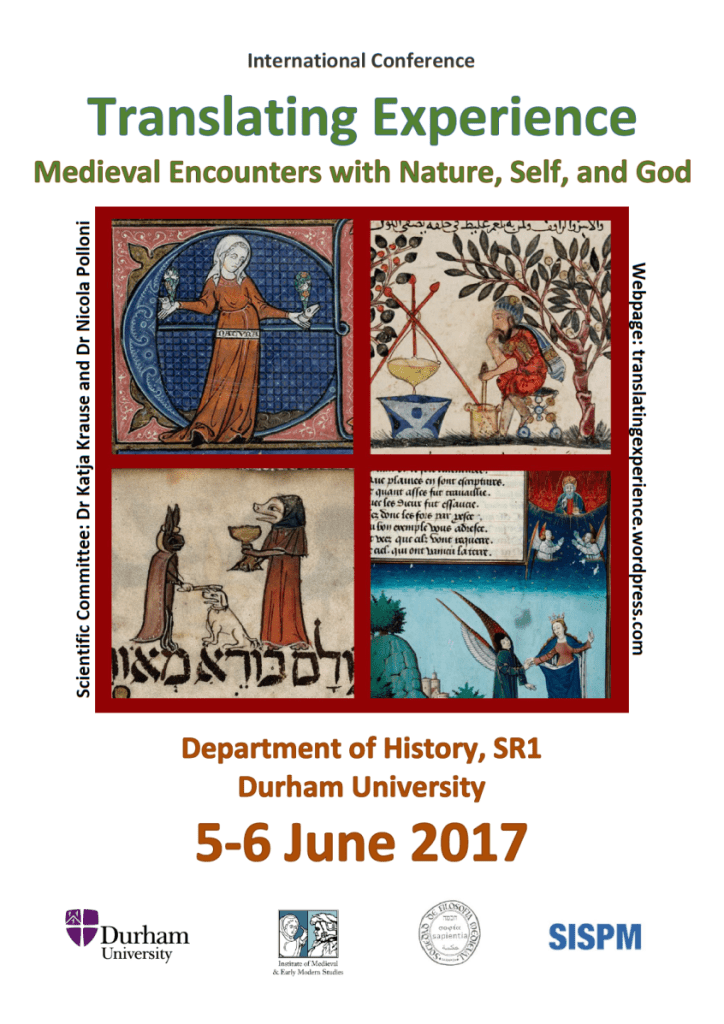
Translating Experience
Medieval Encounters with Nature, Self, and God
Conference, Durham University (UK). 5-6 June 2017.
What is the role of experience in medieval encounters with nature, self, and God? The Aristotelian sciences, such as astronomy and meteorology, zoology and botany, as well as other medieval disciplines such as medicine, alchemy, and magic drew on experience in different ways and to different degrees. Their applications range from singular references to experience in different arguments to collected works of experience, such as the medical literary genre of the experimenta that focuses on medical remedies. Yet the same concepts—tajriba, nissayon, experientia / experimentum—are also used in the encounter with the self; more specifically in the realms of epistemological inquiry, internal reflection on experience of the natural world, or the question of conscience. A third prominent area where experience plays a central role in medieval discourses is encounters with the divine through rapture, prophecy, the practice of magic and necromancy—discourses in which the concept of experience finds its very limits.
Despite their diversity of applications, all three encounters of experience with nature, self, and God seem to share a twofold approach: on the one hand, ‘experience’ is discussed as a noetic object to reflect upon epistemological and psychological questions; on the other hand, ‘experience’ is used as noetic tool to increase, correct, and corroborate the knowledge acquired in the different disciplines. What seems to underlie all encounters with experience and approaches to it, however, are questions of ‘translation’ on the three levels of the conceptual, the linguistic, and the material—translations that cross not only cultural and religious boundaries, but also from the real world to that of parchment.
The aim of our first conference on the vast topic of experience in the medieval world is to explore some fundamental basics in order to begin to conceive of medieval experience in a more nuanced fashion. Among the questions we would like to explore are those concerning three different perspectives:
(1) Experience as a tool of knowledge: How did medieval thinkers draw on experience in these three different encounters of nature, self, and God? Does experience assume different roles and functions within the different disciplines?
(2) Experience as an object of knowledge: Was experience conceived of differently in the two realms of the empirical and the non-empirical? Or was experience thought to involve some common core—a core concept that could be ‘translated’ from one encounter to another and from one realm to another?
(3) The aspect of ‘translating’ experience: How did medieval thinkers negotiate linguistic translations of experience from one scholarly language to another (Arabic, Latin, and Hebrew)? To what extent did these linguistic translations involve trans-cultural and trans-religious translations of experience in theory and practice? How and why did medieval thinkers translate experience from technical and difficult language to a simpler and easy-to-understand language? And last but not least, how did material translations—the very activity of writing experienced events onto parchment—affect the medieval understandings and applications of experience found in their texts?
The conference is sponsored by the Department of History and the Department of Theology of Durham University, the Institute for Medieval and Early Modern Studies (IMEMS), with the support of the Society for Medieval Philosophy (SOFIME) and the Italian Society for the Study of Medieval Philosophy (SISPM).
Organisers: Katja Krause and Nicola Polloni.
Participants: Dragos Calma (University of Cambridge), Mário Correia (Universidade do Porto), David Cory (University of Notre Dame), Therese Cory (University of Notre Dame), Federico Dal Bo (Universidad Autónoma de Barcelona), Nikolaus Egel (LMU München), Steven Harvey (Bar-Ilan University), José Higuera Rubio (Universidade do Porto), Katja Krause (Durham University), Celia López Alcalde (Universidade do Porto), Jon McGinnis (University of Missouri), Nicholas Oshman (Marquette University), Nicola Polloni (Durham University).
Programme
Monday 5 June
First Session
10.30: Katja Krause & Nicola Polloni, The Light of Nature? No “Experience” in the Middle Ages!
11.00: Therese Cory, Aquinas on Experience and Its Scope
11.45: David Cory, The “obscure and hidden” work of the vegetal soul in Thomas Aquinas
Second Session
14.00: Celia Lopez, Experience and Self-Knowledge in Petrus Hispanus’s Theory of the Soul
14.45: Jon McGinnis, A Matter of Priorities: Avicenna’s Solution to Meno’s Paradox and Its implications for the Sciences
15.30: break
15.45: Nicholas Oschman, Translating Truth into Images in al-Fārābī’s Polis
16.30: Federico Dal Bo, The “Sacrifice of Isaac” as God’s Self-Testing in the XIII Century Spanish Kabbalah
17.15: break
17.30: Keynote Speaker: Steven Harvey, The Place of Observation and Experience in the Quest for True Knowledge among Jewish Aristotelians in the Thirteenth and Fourteenth Centuries
Tuesday 6 June
Third Session
09.30: José Higuera Rubio, Ars experimentalis: Experience in Demonstrative and Productive Disciplines
10.15: Dragos Calma, From Senses to the Self and God
11.00: break
11.15: Mário Correia, Experience and Natural Philosophy in Italian Renaissance Scholasticism: Gomes of Lisbon’s Scotistic Response to Nicoletto Vernia
12.00: Katja Krause & Nicola Polloni, The Light of Nature! No “Experience” in the Middle Ages?
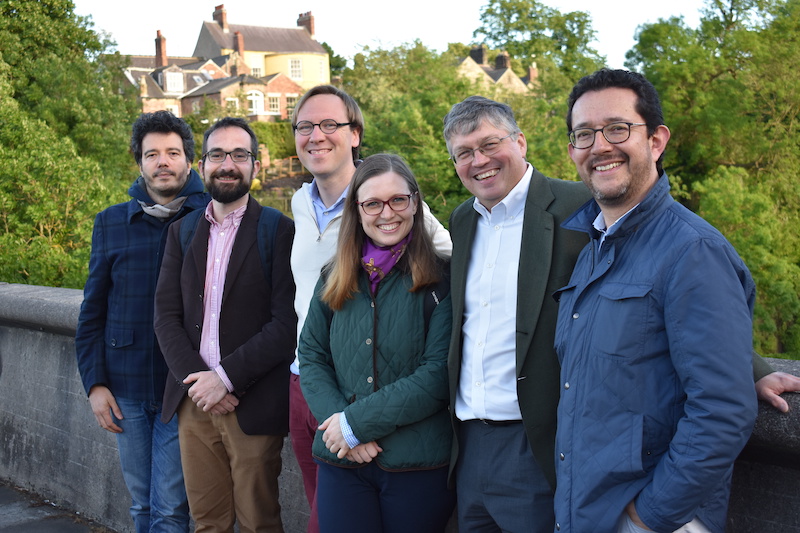
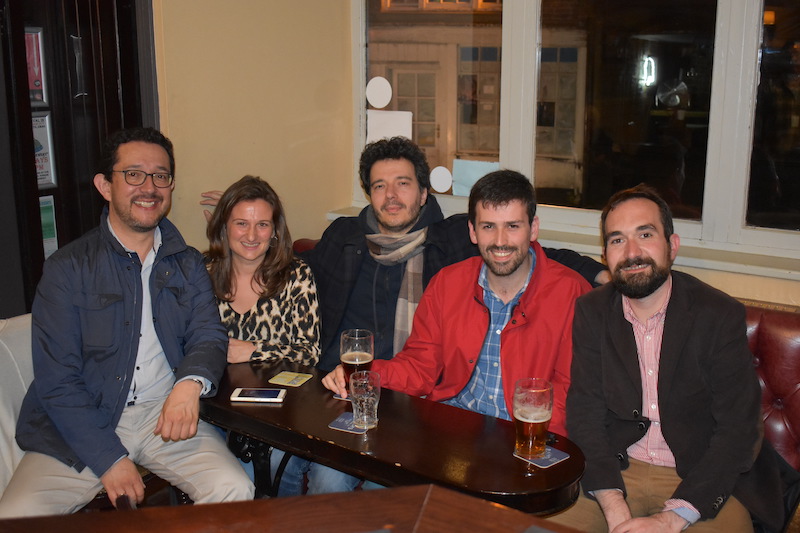
Conference Photos

©️Nicola Polloni | Latest update: June 2017
 Potestas essendi