Late Medieval Hylomorphism: Matter and Form, 1300-1600
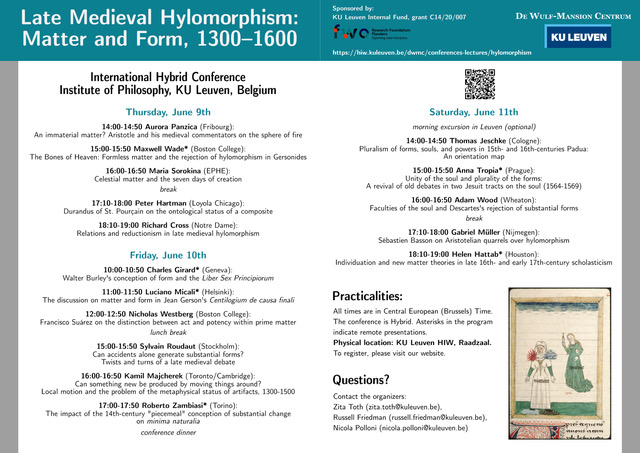
Conference, KU Leuven (BE). 9-11 June 2022.
Later medieval philosophers would claim that all bodies are compounds of matter and form. Yet, among themselves, their ways of conceiving of the two components tended to differ substantively. The conference “Late Medieval Hylomorphism” aims at disentangling the specificities of a long-lasting debate on hylomorphism, the scope and originality of which is still unknown. While hylomorphic issues in the late thirteenth and early fourteenth century have received some scholarly attention, the later history of Scholastic hylomorphism is still to be explored. What were the main disputes concerning hylomorphism in the period? What were the main positions? Who were the interesting thinkers defending unusual points of view? These questions unfold at different levels of the ontological examination of substances. For instance, the debate about the modality of existence of prime matter conceived of as either a pure potency or an entity in act had profound impact on the later tradition up to the seventeenth century. In a similar manner, the contentious thirteenth- and fourteenth-century question of whether there is a plurality of substantial forms in any compound is present into the early modern period; but were new positions, arguments, and ideas develop over the course of the centuries? Moreover, an important view in thirteenth-century hylomorphic debates was the so-called theory of “universal hylomorphism”, which seems to disappear from the later debate; but is this in fact the case? A like question can be asked about the Augustinian notion of seminal reasons (rationes seminales). Additional central questions about the later medieval debate on hylomorphism ask about the ontological distinction between super- and sublunary matters, and the roles played by prime matter and substantial form in the process of substantial change. And underlying all these issues, thinkers had to address the lurking worry that no well-grounded reasoning on matter and form is possible when neither of the hylomorphic constituents can be known.
Organisers: Zita Toth, Russell Friedman, and Nicola Polloni.
Participants: Richard Cross, Charles Girard, Peter Hartman, Helen Hattab, Thomas Jeschke, Kamil Majcherek, Luciano Micali, Gabriel Müller, Aurora Panzica, Sylvain Roudaut, Maria Sorokina, Anna Tropia, Maxwell Wade, Nicholas Westberg, Adam Wood, Roberto Zambiasi
Programme
Thursday, 9 June 2022
13:30 Arrivals, coffee, opening remarks
Session 1, chaired by Zita Toth
14:00-14:50 Aurora Panzica (Fribourg): “An immaterial matter? Aristotle and his medieval commentators on the sphere of fire”
15:00-15:50 Maxwell Wade* (Boston College): “The Bones of Heaven: Formless matter and the rejection of hylomorphism in Gersonides”
16:00-16:50 Maria Sorokina (EPHE): “Celestial matter and the seven days of creation”
coffee break
Session 2, chaired by Luca Burzelli
17:10-18:00 Peter Hartman (Loyola Chicago): “Durandus of St. Pourçain on the ontological status of a composite”
18:10-19:00 Richard Cross (Notre Dame): “Gregory of Rimini’s moderately idealist hylomorphism and the complexe significabile“
Friday, 10 June 2022
Session 3, chaired by Nicola Polloni
10:00-10:50 Charles Girard* (Geneva): “Walter Burley’s conception of form and the Liber Sex Principiorum“
11:00-11:50 Luciano Micali* (Helsinki): “The discussion on matter and form in Jean Gerson’s Centilogium de causa finali“
12:00-12:50 Nicholas Westberg (Boston College): “Francisco Suárez on the distinction between act and potency within prime matter”
lunch break
Session 4, chaired by Clelia Crialesi
15:00-15:50 Sylvain Roudaut (Stockholm): “Can accidents alone generate substantial forms? Twists and turns of a late medieval debate”
16:00-16:50 Kamil Majcherek (Toronto/Cambridge): “Can something new be produced by moving things around? Local motion and the problem of the metaphysical status of artifacts, 1300-1500”
17:00-17:50 Roberto Zambiasi* (Torino): “The impact of the 14th-century “piecemeal” conception of substantial change on minima naturalia“
conference dinner
Saturday, 11 June 2022
morning excursion in Leuven (optional)
Session 5, chaired by Virginia Scribanti
14:00-14:50 Thomas Jeschke (Cologne): “Pluralism of forms, souls, and powers in 15th- and 16th-centuries Padua: an orientation map”
15:00-15:50 Anna Tropia* (Prague): “Unity of the soul and plurality of the forms: A revival of old debates in two Jesuit tracts on the soul (1564-1569)”
16:00-16:50 Adam Wood (Wheaton): “Faculties of the soul and Descartes’s rejection of substantial forms”
coffee break
Session 6, chaired by Russell Friedman
17:10-18:00 Gabriel Müller (Nijmegen): “Sébastien Basson on Aristotelian quarrels over hylomorphism”
18:10-19:00 Helen Hattab* (Houston): “Individuation and new matter theories in late 16th- and early 17th-century scholasticism”
Closing remarks
©️Nicola Polloni | Latest update: July 2022
 Potestas essendi