
Visiting Messina
An Incredibly Concise Guide for Your Stay
I have put together a brief (and intentionally informal) guide with some practical tips to help you make the most of your stay in Messina while we do some exciting medieval philosophy together. Think of it as a small survival kit for navigating the city between seminars, debates, and the occasional metaphysical revelation, with just enough local knowledge to keep you well fed, well oriented, and reasonably on schedule.
You can also access the map I created, which pinpoints the places mentioned throughout the guide, so you can move from “I’ve heard of that church” to “I am standing in front of it” with minimal effort. Please note that both the guide and the map are periodically updated, so if something looks slightly different from what you remember, it is probably not a case of temporal instability, but simply me tweaking the website again.
Welcome to Messina
Messina –the ancient Zancle – is a city with a rich history dating back to the 8th century BCE. Today, Messina is a fascinating modern town where contemporary architecture blends seamlessly with medieval historical buildings. Natural events have not been kind to Messina: a series of devastating earthquakes – the last in 1908 – destroyed much of the old town. However, part of it has been carefully restored or reconstructed. Despite the destruction (further exacerbated by WWII bombings), Messina has remarkably recovered, and over the past decade, it has emerged as one of the most captivating yet underrated cities in Southern Italy. Messina is also home to one of the oldest universities in Italy and its vibrant academic community, with which you will likely have many opportunities to engage. This short guide will provide useful information for your stay – whether for a conference, a research visit, or any other occasion to dive into some wild medieval philosophy together!
Getting to Messina
From Villa San Giovanni
If you arrive at Aeroporto dello Stretto (in Reggio Calabria) or travel by train from the mainland, you’ll disembark in Villa San Giovanni, a small town facing Sicily. From there, you will need to take a ferry to Messina. Depending on where you want to go in Messina (the city center or the northern part of the city), you have two options:
Caronte&Tourist (https://carontetourist.it/en/caronte). This ferry will take you to the C&T dock in the northern part of Messina (see the map)
BlueJet (https://www.blujetlines.it/). This ferry will take you to the main port of Messina, which is very close to the train station (see the map)
Please note that the two ferries depart from different docks. BlueJet’s dock is directly in front of the train station (on the coast side), while Caronte’s dock is about a 15-minute walk from there; turn right after exiting the station (coast side). You can purchase tickets at offices near the respective docks or via the Caronte App (if you plan on using their services). The trip takes about 30 minutes and offers stunning views of the Messina Strait and the beautiful coastline on both sides.
From Catania
If you land in Catania, you may prefer to travel to Messina by train. Catania Airport has a train station, although it is about a 10-minute walk from the airport (see the map). You will likely need to disembark at Catania Centrale and transfer to another train bound for Messina Centrale. You can plan your itinerary on the Trenitalia website, or even better, download the Trenitalia App, where you can both plan your trip and purchase tickets.
Keep in mind that regional train tickets (i.e., all tickets except for high-speed trains such as Frecciarossa and Intercity) do not include seat reservations. If you are using a paper ticket, it must be validated at a machine in the station. For virtual tickets purchased via the Trenitalia App, validation is automatic and happens at the time of the train’s scheduled departure – even if the train is running late.
There are also coaches available from Catania Airport directly to Messina (Sais Autolinee). You can find more information at the following page.
From Palermo
If you land in Palermo, the trip to Messina will take a bit longer (about 2 hours and 40 minutes by either train or bus from Palermo Centrale). First, you will need to reach the main train station from the airport. You can do this either by train (which runs approximately once per hour) or by coach service (Prestia e Comandè), with information available directly at the airport.
Once you arrive at Palermo Centrale, you can either take a train directly to Messina or walk a few minutes to the coach station, located just behind the train station, and take a bus. The coach company is Sais Autolinee, and you can purchase a ticket through their website/app or directly when boarding, provided seats are available.
If you opt for the train, do not forget to validate your ticket. As stated above, for virtual tickets purchased via the Trenitalia App, validation is automatic and happens at the time of the train’s scheduled departure – even if the train is running late.
Getting to the department
It’s very likely that whatever we have to do together will take place at my department, the Dipartimento di Civiltà Antiche e Moderne (Department of Ancient and Modern Civilizations), also known by its acronym, DICAM. The department is located in the Campus Annunziata, specifically at Viale Giovanni Palatucci 13, on the northern hillside of Messina. Once you arrive on campus, you cannot miss the department’s beautiful light-blue glass building (see picture below).
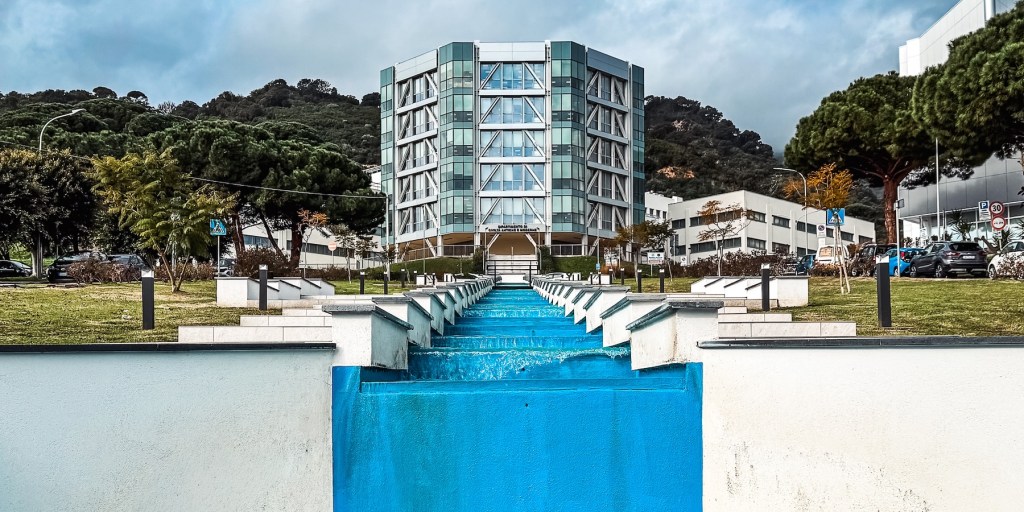
Although it is possible to walk there from downtown Messina, it is a beautiful route that takes over an hour and ends with a fairly demanding climb. Depending on where you are staying, you may prefer to take a bus or call a taxi, but if you do decide to walk, you will be rewarded with impressive views over the Strait… and a very honest conversation with your legs.
Two bus lines serve the campus: Line 23 (uphill) and Line 22 (uphill). Both stop at the Museo bus stop and follow Viale Annunziata all the way up to the campus (see the map). You can board the bus at any of the stops along the way. If you are coming from downtown Messina, you can either walk to the Museo stop or take Line 1 (direction Torre Faro) or the tramway from the train station, getting off at the Museo stop.
Confusing, right? The easiest way to navigate Messina’s bus system is to download the ATM App, the official app of the local transportation authority. It provides useful information to help plan your trip, and most importantly, allows you to purchase your bus ticket. Remember to validate your ticket once you board: for paper tickets, use the validation machine, and for app-based tickets, click the “validate” button in the app. Also, most bus stops have QR codes: if you scan them with your phone, you can see real-time estimates of when the next bus is expected to arrive.
If you prefer taking a taxi, you can either call one or find one at a taxi stand (for example, in front of the train station). Keep in mind that taxis do not stop if you wave them down on the street. You can request a taxi service by calling the following number: +39.090.6505 (Radio Taxi Jolli Messina). There are other taxi services in Messina, but this is among the most reliable. Depending on where you are located and the time of day (night fares are higher), a taxi from the city center to the department will cost more than 25 euros. That is why taking the bus is usually the better option.
Accommodations
Messina is neither Rome nor Palermo, so accommodation options are somewhat limited. Below, you will find a list of accommodations near the department (which are not very close to the city center) and a list of accommodations downtown (which, in turn, are not very close to the department). Depending on your preferences and needs, you can choose one of these options.
Please note that I am not endorsing any of these accommodations, and I am unfamiliar with their services, prices, or overall quality. I have simply focused on their location. Before making a reservation, you might want to check reviews on Booking.com to see how they have been rated by previous guests.
Close to the department
Not necessarily at walking distance, though.
- B&B Villa Agrumé: Via Luigi Einaudi 10
- Villa Scilla e Cariddi: Viale Annunziata – angolo Via G.A. Bosurgi, 20
- B&B Bonlet: Località Santissima Annunziata, 4
- Residence Annunziata : Viale Annunziata 91/A
- B&B Regina 381 : Viale Regina Elena, 381
Close to the city centre
Yet far away from the department.
- Hotel Royal Palace: Via Tommaso Cannizzaro 3
- Hotel Messenion: Via Faranda 7
- Hotel Sant’Elia: Via I Settembre 67
- Hotel CineApollo: Via San Filippo Bianchi 23
Feeling hungry?
There are two cafés on campus. One is on the ground floor of the department building: just walk to the right instead of taking the staircase and you will find it! The other one is located quite close to the department, as shown on the map. It has a terrace with table and it’s a great place to spend some relaxing time while drinking a coffee. There are also vending machines available in the department. However, if you are looking for restaurants, bars, or bakeries, you will need to walk a few minutes downhill.
While in Messina, be sure to try some of the local delicacies. Sicily is renowned for its great food and distinctive flavours, and the Strait of Messina is particularly famous for its swordfish. Some dishes you may want to sample include arancino (pl. arancini; deep-fried rice ball), traditionally filled with meat sauce or ham and cheese; pitone (pl. pitoni; deep-fried stuffed pastry), a large fried turnover with various fillings; and involtini di pesce spada (swordfish rolls), filled with breadcrumbs and aromatic herbs. Another local favourite is focaccia messinese (Messina-style focaccia), a soft, thick focaccia typically topped with escarole, tomatoes, anchovies, and tuma cheese.
If you enjoy seafood, you may also want to try pasta con il pesce spada (pasta with swordfish), stoccafisso alla messinese (stockfish Messina-style), and other Strait-inspired dishes, often prepared with simple, bold ingredients that let the fish shine.
For dessert, do not miss pignolata messinese (glazed fried dough bites; you may want to look online for a detailed description), a dangerously moreish local speciality. And of course, no Sicilian food tour would be complete without classics such as granita con brioche, cannoli (ricotta-filled pastry tubes), pasta alla Norma (pasta with aubergines and ricotta salata), and pistachio-based treats.
The map includes suggestions for places and restaurants where you can explore these culinary delights.
What to see in Messina
Messina offers a wonderful mix of monumental landmarks, hidden architectural gems, and panoramic viewpoints, and the following stops are among the city’s essentials. Start from the Cathedral of Messina, originally dating back to the twelfth century and rebuilt after the earthquake: it remains the symbolic heart of the city. Right next to it, the Bell Tower houses one of the largest astronomical clocks in the world, and it is well worth being there at noon, when the mechanism comes to life.
A short walk away, you will find two of Messina’s most celebrated fountains. The Fountain of Orion, a splendid sixteenth-century work by Giovanni Angelo Montorsoli, is one of the city’s most elegant Renaissance monuments. Not far from it stands the Fountain of Neptune, also by Montorsoli, dominated by the sea god himself and one of the most striking pieces of civic sculpture in Messina.
For architecture lovers, Santissima Annunziata dei Catalani is unmissable: one of the oldest surviving buildings in the city and a remarkable example of Arab-Norman influence. Another important stop is the Church of San Francesco, among Messina’s oldest churches (thirteenth century), admired for its Gothic character and historical atmosphere.
If you would like to add a museum visit to your itinerary, the Messina Regional Museum is a real highlight, with a rich archaeological and artistic collection, including masterpieces by Caravaggio and Antonello da Messina.
For sweeping views, head up to the Tempio di Cristo Re, famous for its huge dome and its commanding position above the city. It is one of my favourite places in Messina, and I genuinely recommend not skipping it. Nearby, the Sanctuary of the Madonna di Montalto offers another excellent panoramic viewpoint, perfect for taking in the city’s layout and the shimmering line of the Strait.
Finally, if you have time to venture beyond the centre, make your way north towards Ganzirri, a picturesque village set between two small lakes and the sea, well known for its excellent fish restaurants. From there, continue to Torre Faro, at the island’s easternmost tip: a charming fishing village where Sicily feels as if it is reaching out towards Calabria.
For a broader and more intuitive introduction to Messina and its surroundings, you can also explore the Visual Notebook I prepared, which offers a richer sense of the landscape, atmosphere, and views that make this corner of Sicily so distinctive (see below for more visual guides to the area).
Wandering Around the Messina Area
If you are feeling overwhelmed by academic work and need a change of pace, Messina is an excellent base for day trips, with an extraordinary variety of landscapes and towns within easy reach. The options below are not meant to be exhaustive, but they bring together some of the places that, in my view, are truly worth your time.
If you can make just one trip, Mount Etna should be at the top of the list. It is remarkably close to Messina and offers a genuinely one-of-a-kind experience: walking on volcanic slopes feels like stepping into another world. It is by far my favourite place in Sicily (and one of my favourite places in general), and I strongly recommend going, even if only for a few hours, to experience its scale and atmosphere.
If the weather allows, it is also possible to hike up towards the main craters, but please note that, by Italian law, access to the summit area and the main craters is only permitted with a volcanological guide. This is not just a formality: conditions on Etna can change quickly, and having an expert with you makes the experience both safer and far more interesting. The hike itself can be quite demanding and requires proper preparation (good footwear, warm layers even in summer, water, and a reasonable level of fitness), but the reward is extraordinary: vast black landscapes, sudden bursts of colour in the rocks, and views that feel almost unreal.
If you would like to organise the trip in the best possible way, feel free to reach out to me. I am well acquainted with an excellent volcanological guide who can tailor the experience to different levels and interests, and who knows how to bring people to truly remarkable places on the mountain.
If you are tempted by the sea, the Aeolian Islands are an unforgettable escape: volcanoes rising from the water, dramatic coastlines, and small villages that seem designed for slow afternoons. Lipari, Vulcano, Salina, Stromboli, Filicudi, Alicudi, and Panarea each have their own character, and even a short visit can feel like a different universe. There are direct ferries from Messina to Vulcano and Lipari, although the frequency varies by season, so it is best to check schedules in advance. Alternatively, you can travel to Milazzo (about 30 minutes from Messina by train), where ferries and connections to the islands are usually more frequent.
One important note: the weather can be tricky, particularly from late autumn through early spring, and this may affect sea conditions. As a result, ferries do not always run exactly as scheduled, and delays or cancellations are possible. In rare cases, you might even find yourself “stuck” on the islands for an extra day or two, which is not ideal for tight plans, but certainly an unexpectedly memorable way to extend the adventure.
A particularly charming trip takes you across the Strait to Scilla, a wonderfully preserved fishing village on the Calabrian side, and absolutely worth the journey. You can take a ferry from the Caronte dock to Villa San Giovanni, and from there reach Scilla with a short train ride of around ten minutes. That said, while the ride itself is brief, train connections from Villa San Giovanni to Scilla are not very frequent, so it is always best to check timings in advance on the Trenitalia app. Alternatively, there are frequent buses, which can be a very convenient option.
Once there, you will find a truly beautiful seaside setting, including a gorgeous beach that is perfect for a swim, although it can become very crowded in summer. The historic heart of Scilla is also well worth exploring: wander through Chianalea, the old fishermen’s quarter built right on the water, and make your way up to Castello Ruffo, which offers wonderful views over the coast and the Strait. And, of course, while you are there, be sure to try the local swordfish sandwich and a granita di bergamotto (bergamot granita), two specialities that feel perfectly at home in that landscape.
For a classic Sicilian postcard, Taormina is an easy and rewarding trip from Messina by train. There is little to add to its reputation, but a few practical notes help: once you arrive at the train station, you can either take a bus up to town or walk uphill yourself, which is a challenging but memorable ascent. If possible, avoid high season and weekends, when the crowds can overwhelm the experience. And if you have time, the nearby archaeological site of Naxos is well worth including in the same outing.
If you prefer an urban day out, Catania makes for a fascinating contrast. Built from volcanic stone and shaped by Etna’s presence, it has a distinctive, dark elegance and a lively centre unfolding around the Cathedral. Do not miss Castello Ursino and its museum, and make sure you try a proper pasta alla Norma (pasta with aubergines and ricotta salata) while you are there.
Beyond these destinations, there is no shortage of places to explore depending on your mood, the season, and how much time you have. If you feel like slowing down and discovering smaller towns with a strong sense of place, Savoca and Itala are both excellent choices: they offer beautiful views, a quieter rhythm, and the kind of streets where you naturally end up wandering without a plan. For something a little different, Santo Stefano di Camastra is famous for its long tradition of handmade ceramics, and it is a wonderful place to browse colourful workshops and bring back something genuinely local.
If you want a seaside day with an easy atmosphere, Milazzo is a great option: a pleasant coastal town with a lovely waterfront and the added advantage of being one of the main gateways to the Aeolian Islands. Crossing the Strait in the other direction, Reggio di Calabria makes for a very rewarding visit, especially for its museum housing the extraordinary Bronzi di Riace, which alone are worth the trip.
For a change of scenery, Sicily also offers dramatic natural landscapes within reach: the Gole dell’Alcantara, with their striking lava-stone gorges and cold river water, are particularly memorable, especially on warmer days. Cefalù is a wonderful option a little farther away (around two hours by train), combining a beautiful historic centre with a seaside setting that feels effortlessly iconic. And if you feel like turning a day trip into something longer, direct trains can take you to Syracuse and Palermo, opening up even more of Sicily’s western and southern horizons, with enough art, history, and food to justify at least an overnight stay.
Final pieces of information
The European emergency number is 112. By calling it, you can reach the police, emergency health services, and all other life-saving services. If you need anything else, feel free to call me anytime (I assume you have my phone number).
Be especially cautious when crossing the streets in Messina. Sicilian drivers have a ‘peculiar’ driving style, which may differ significantly from what you are used to in Northern Europe or North America. Do not expect drivers to automatically stop at zebra crossings. Be extra careful in areas where sidewalks are narrow.
While Messina is not a dangerous city, it is wise to be vigilant when using public transportation, especially if you plan to visit nearby tourist hotspots like Taormina, Syracuse, Catania, or Palermo. Always keep an eye on your belongings and never leave them unattended.
Check this page for updated versions of this guide and the map I have prepared for you.
Latest update: January 2026
 Potestas essendi