HYLOGLOB
HYLOGLOB (Hylomorphism in a Globalising World: Scholastic Debates on the Ontology of Nature Across Europe, China, and New Spain) is a research project funded by the European Union’s Marie Skłodowska-Curie Action (MSCA-IF) delving into 16th-century scholastic theories of the ontological constitution of the natural world and their global impact. The project starts at UCLouvain (Louvain-la-Neuve, BE) in October 2023, and it is based there until January 2024 thanks to a fantastic secondment at the Institut supérieur de philosophie (ISP) working with Jacob Schmutz and his team.
From February 2024, the main base will be the Institute of Philosophy of the University of Porto (Porto, PT) and, in the February 2025 it will move once again, this time to Guangzhou (CN), for another secondment at Sun Yat-sen University, where I will be working with Thierry Meynard and his team.
IMPORTANT NOTICE: Due to my professorship in Messina, HYLOGLOB has ended in January 2024.
HYLOGLOB aims at disentangling the metaphysical theories about the constitution of physical substances that have been produced in the 16th-c. debate and used as interpretative lenses to understand metaphysical and physical doctrines formulated in China and New Spain. You can find more info about HYLOGLOB’s aims and structure in the project description down below. As I started my tenure in Messina only a few months after HYLOGLOB begun, the project implementation was short lived. Yet, I will carry on the research nonetheless from beautiful Messina.
Read the project description
While sailing from Portugal to Asia in 1578, the Italian Jesuit Matteo Ricci could have never imagined that, for over three decades, he would use the philosophical training he had received in Europe to try and understand sophisticated metaphysical doctrines developed in China over thousands of years. Like his European contemporaries in Asia and America, he made sense of these novel, utterly different systems of thought by a process of philosophical accommodation and reinterpretation that often reshaped their meaning considerably. Textual traces and historical reconstructions of the first cultural exchanges between Europe, China, and New Spain show that such processes of accommodation and reinterpretation were based on 16th-c. Scholasticism.
Like Ricci, the European intellectual elites that moved to these “peripheries” (missionaries, teachers, explorers, state delegates, etc.) had received a Scholastic education and used its schemes to decode new cultural settings. HYLOGLOB’s main hypothesis expands on this reconstruction to maintains that, insofar as natural philosophy and metaphysics are considered, non-European philosophies and cultures were read through the lenses of the 16th-c. Scholastic debate on the constitution of physical substances.
By analysing this debate, the project reconstructs the interpretative tools that were employed in the processes of philosophical accommodation of non-European theories about nature and the universe. HYLOGLOB aims at disentangling the metaphysical theories about the constitution of physical substances that have been produced in the 16th-c. debate and used as interpretative lenses to understand metaphysical and physical doctrines formulated in China and New Spain.
The Scholastic debate on the constitution of physical substances originated from a complex question: How can we describe ontologically the natural things (res) we see in our world, like a squirrel or a lump of metal? 16th-c. Scholastic philosophers claimed that these bodies are metaphysically made of two entities, namely, prime matter and substantial form (an Aristotelian theory called “hylomorphism”). While harsh controversies accompanied its reception in Greek, Arabic, and Latin settings, hylomorphism was the cornerstone of the Scholastic interpretation of the universe.
For Scholastic thinkers, the world was structured hylomorphically: physical phenomena of all sorts could be explained according to the hylomorphic constitution of the bodies involved. Hylomorphism, however, was not the only explanatory tool that Scholastic philosophers had to understand the natural world. For them, natural substances are also physically composed of another kind of parts: uniform mixtures made of elements. Indeed, following a different line of Aristotle’s thought, Scholasticism also maintained that all physical bodies are ultimately composed of elements. These elements, too, are hylomorphic compounds, but they are only virtually present in the bodies. Indeed, neither matter nor the form or the elements are integral parts of the body, but rather metaphysical components working as its principles.
HYLOGLOB aims at disentangling the metaphysical theories about the constitution of physical substances that have been produced in the 16th-c. debate and used as interpretative lenses to understand metaphysical and physical doctrines formulated in China and New Spain. The Scholastic debate on the constitution of physical substances originated from a complex question: How can we describe ontologically the natural things (res) we see in our world, like a squirrel or a lump of metal?
16th-c. Scholastic philosophers claimed that these bodies are metaphysically made of two entities, namely, prime matter and substantial form (an Aristotelian theory called “hylomorphism”). While harsh controversies accompanied its reception in Greek, Arabic, and Latin settings, hylomorphism was the cornerstone of the Scholastic interpretation of the universe. For Scholastic thinkers, the world was structured hylomorphically: physical phenomena of all sorts could be explained according to the hylomorphic constitution of the bodies involved.
Hylomorphism, however, was not the only explanatory tool that Scholastic philosophers had to understand the natural world. For them, natural substances are also physically composed of another kind of parts: uniform mixtures made of elements. Indeed, following a different line of Aristotle’s thought, Scholasticism also maintained that all physical bodies are ultimately composed of elements. These elements, too, are hylomorphic compounds, but they are only virtually present in the bodies. Indeed, neither matter nor the form or the elements are integral parts of the body, but rather metaphysical components working as its principles.
The interrelation and opposite functionality of these two theories (hylomorphism and the theory of the elements) originated a vast array of controversies and debates that culminated chronologically in the 16th-c. debate on the constitution of physical substances. This debate was built upon questions and problems about the three main constituents of physical substances, which are also the three topical features (TF1-3) of that debate: prime matter, substantial forms, and elements. In the case of prime matter (TF1), crucial frictions originated from its functional duality as (1) enduring substrate of substantial change and (2) metaphysical potentiality intrinsic to the body. This friction led to a prioritisation of either one of these functions, with Scotistic and Thomistic trends that were equally open to philosophical liabilities. 16th-c. philosophers struggled to elaborate possible solutions, often maintaining that matter was endowed with some actuality, features, and/or accidents (esp. quantity). HYLOGLOB examines how historical actors engaged with this elusive entity, analysing the solutions they proposed to justify prime matter’s actuality/potentiality, quantity, and conceivability.
PROJECT TEASER
HYLOGLOB at UC Louvain
From the 16th century onwards, people, books, and ideas start to move globally. Although resulting from reprehensible colonialist tendencies that mark Europe at the time, this global circulation of knowledge nurtured a new way to tackle the natural world and its metaphysical foundations. While the common narrative tells a story in which the prodromes of the scientific revolution gradually evolve throughout this period, HYLOGLOB focuses on a different yet crucial aspect characterising the 16th and 17th centuries: the use of hylomorphism as primary explanatory device to understand non-European philosophical traditions and physical practices.
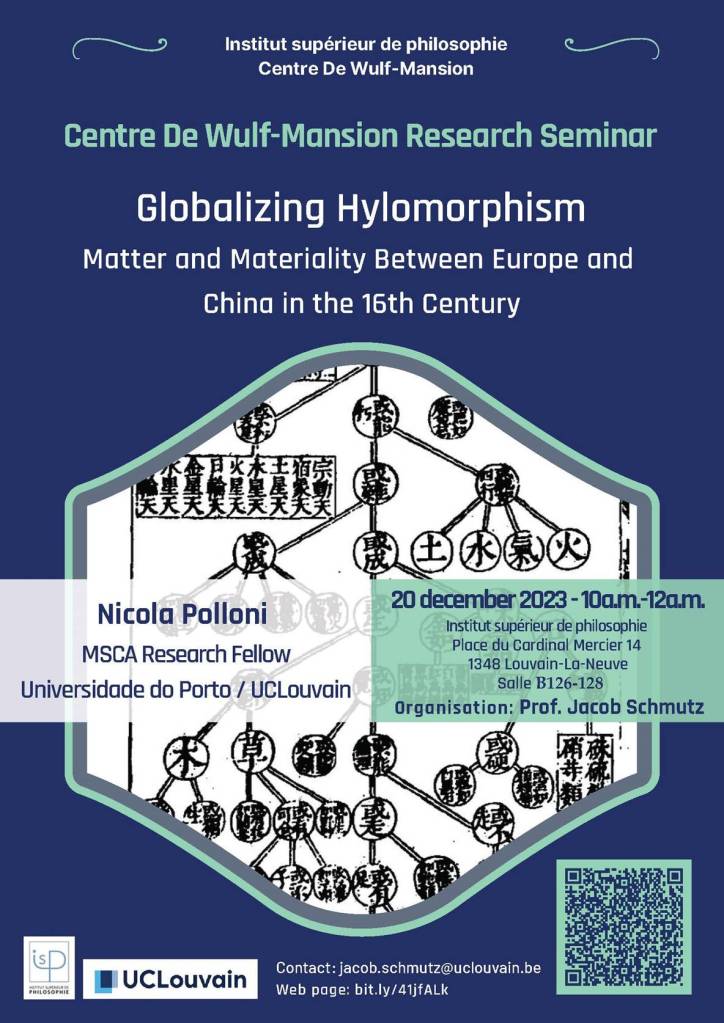
During its implementation at UCLouvain (October 2023-January 2024), HYLOGLOB’s main focus is the reconstruction of the circulation of the main ideas and texts about hylomorphism that moved from Europe to New Spain and China. Working with Jacob Schmutz’s team at the Institut supérieur de philosophie, the project will shed light on the material availability of philosophical texts in these areas. The latter is a preliminary condition for the analysis of the impact of scholastic hylomorphism in situ and the reception of new theories and claims proceeding from these areas to Europe.

HYLOGLOB in Beijing
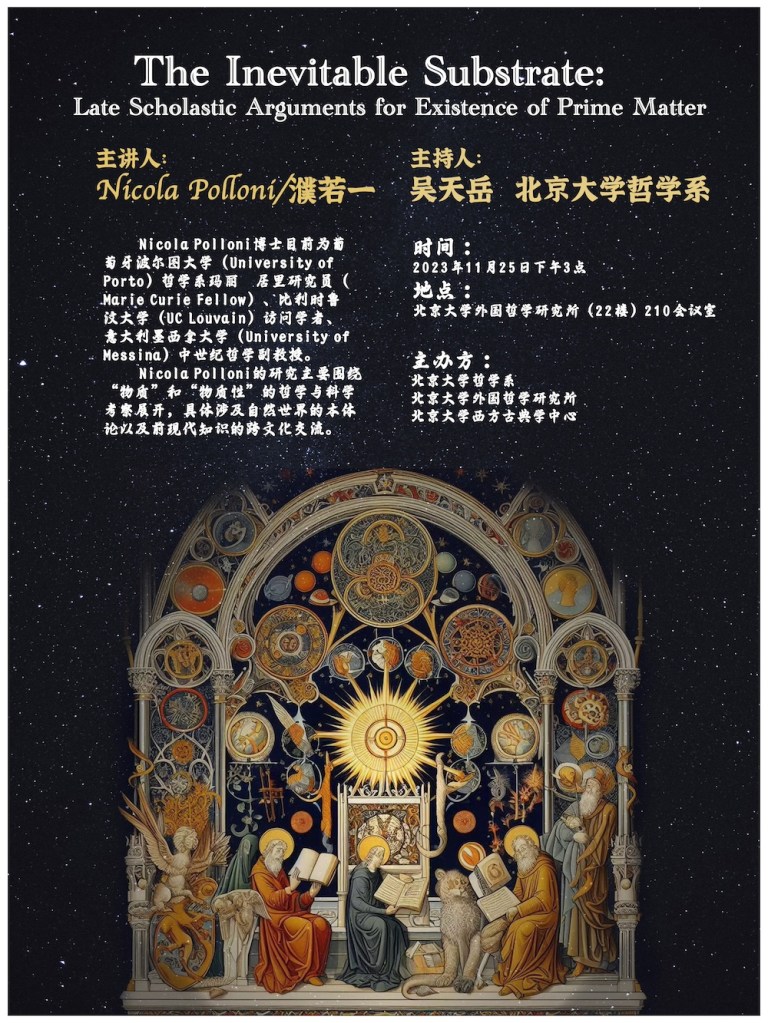
Following a generous invitation by the Institute for Cultural Heritage and History of Science and Technology of USTB Beijing, I am going to spend a month in Beijing working with Shixiang Jin on comparative metaphysics, cross-cultural pollination, and the global history of natural philosophy. In this page, you will find more info on my activities in China in November-December 2023 – the first of a series of planned visits to foster a new, multifocal way to engage with metaphysics and natural philosophy in their global historical course.
You can read here a summary (by Cao Shenghao) of this superb experience.
academic activities



 Potestas essendi