
Glimpses of the Invisible
Visualising the Principles of Nature Before the Rise of Modernity
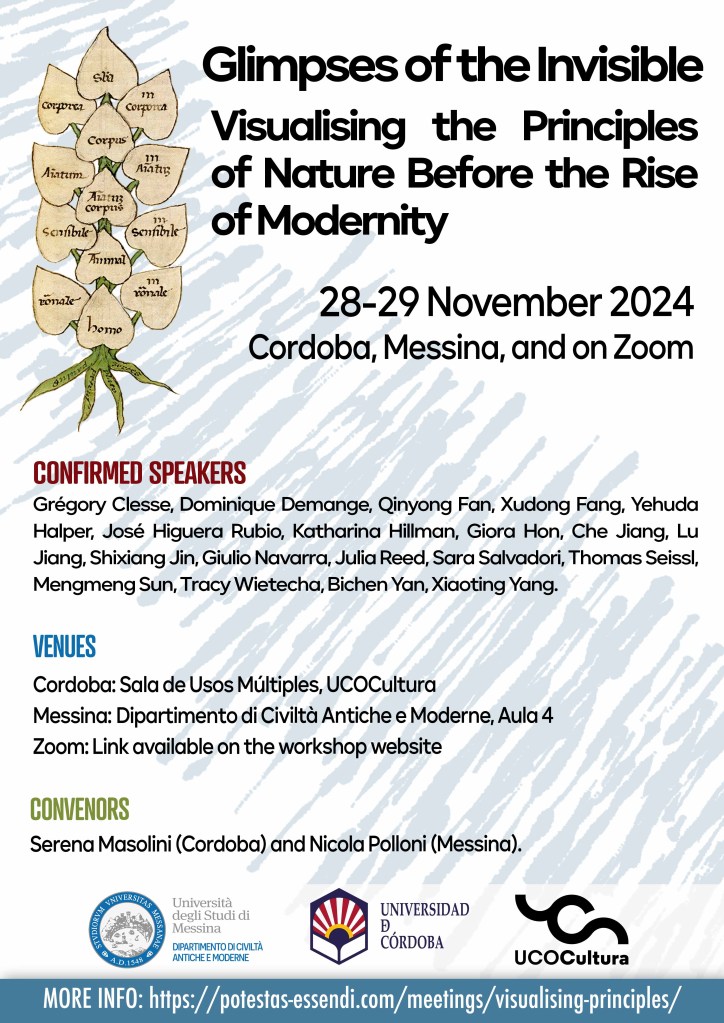
Workshop (hybrid), Cordoba (ES) and Messina (IT), 28-29 November 2024. YouTube Teaser
In their historical course, philosophy and science have sought to understand the intrinsic functioning of the natural world. However, beneath the observable physical objects, these disciplines often envisioned a rich structure of unperceivable entities that were believed to constitute what we see in our world as either principles or basic constituents. This population encompasses series of physical objects too small to be seen (such as elements, atoms, and corpuscles), real entities lacking physicality (such as those maintained by late scholastic hylomorphism), onto-cosmological principles (such as 氣/qi, 理/li, and 太極/taiji in Chinese philosophy), as well as imaginary and abstracted objects of different kinds. The workshop Glimpses of the Invisible: Visualising the Principles of Nature Before the Rise of Modernity aims to explore how premodern philosophers and scientists engaged with the visual representation of these principles and entities, as well as their interactions.
These objects, being unperceivable, necessitated processes of abstraction (and sometimes, analogical transfer) from the manifold instances of physical bodies in which they reveal themselves. At times, this process resulted in the creation of explanatory diagrams, such as Zhou Dunyi’s 太極圖, whose impact transcended their initial clarificatory function to become self-standing theoretical devices. On other occasions, charts and schemes employed to elucidate the interconnections among abstract entities at times resulted in a reification of the entities they sought to clarify, as exemplified by the varied reception of Porphyry’s tree. Beyond abstraction, the study of how physical entities behave prompted the position of imaginary objects whose representation, as in the case of the celestial spheres, sometimes led to their ‘concretisation’ into new real entities.
Glimpses of the Invisible aims to shed light on the interconnection between theorisation and representation of the principles of nature. Whether these entities were considered as real, abstract, imaginary, or symbolic, the chosen means of representation often transcended their clarificatory function and laid the ground for new claims in ontology, natural philosophy, and science. By opening the discussion to various forms of visualisation (including diagrams, illuminations, charts, schemes, etc.) and diverse textual genres (from philosophical and religious commentaries to scientific treatises), the workshop seeks to start a global discussion on the interplay between abstract theorisation and graphic representation of natural principles in different linguistic and cultural settings. The goal is to foster a more nuanced appreciation of the impact that visualisations may have (and have had) on the theories they complement and their later interpretations.
Organisers: Serena Masolini (Universidad de Córdoba), Nicola Polloni (Università di Messina)
Scientific Committee: Qinyong Fan (Yangzhou), Jules Janssens (Leuven), Shixiang Jin (Beijing), Katja Krause (Berlin), María del Carmen Molina Barea (Córdoba), Francesca Pentassuglio (Messina), Michela Pereira (Florence)
Speakers: Grégory Clesse (Louvain-la-Neuve), Dominique Demange (Paris), Qinyong Fan (Yangzhou), Xudong Fang (Shanghai), Yehuda Halper (Tel Aviv), José Higuera Rubio (Madrid), Katharina Hillman (Bar Ilan), Giora Hon (Haifa), Che Jiang (Beijing), Lu Jiang (Guangzhou), Shixiang Jin (Beijing), Giulio Navarra (Foggia), Julia Reed (Bar Ilan), Sara Salvadori (Florence), Thomas Seissl (Fribourg), Mengmeng Sun (Beijing), Tracy Wietecha (Berlin), Bichen Yan (Beijing), Xiaoting Yang (Hangzhou)
attendance
The workshop will be conducted in a hybrid format on 28-29 November 2024, offering participants and attendees the option to either attend in person at one of the two venues (Cordoba and Messina) or join remotely via Zoom. If you plan to attend in person, you can download the guides we have created to help you plan your stay using the buttons below. Please, note that unfortunately the organisers are unable to cover any expenses.
Zoom link (valid for both days):
https://us06web.zoom.us/j/82715182816?pwd=8zabQwtYlZ9aiLDqnyOegXDaKTUzBJ.1
PROGRAMME
All times are in Central European Time (CET).
28 November 2024
9.30-9.40: Serena Masolini and Nicola Polloni, Introductory words
Session 1 | Nature and the Divine
9.40-10.20: Yehuda Halper, Ecce Homo: Charting Human and Divine, Substance and Property, in Contradictory Syllogisms in a Short, Anonymous Text in Three Manuscripts
10.20-11.00: Sara Salvadori, The Poetry of Revelation: The Image of the Cosmological Instrumentum in the Visions of Hildegard von Bingen
11.00-11.30: coffee break
Session 2 | The building blocks of nature
11.30-12.10: José Higuera Rubio, Flowing Points, Wavered Lines and Twisting Surfaces: The Geometrical Embodiment of Elemental Composition
12.10-12.50: Lu Jiang, The Nature of Change – Diagram of the Four Terrestrial Elements in Qiankun Tiyi
12.50-14.30: lunch break
Session 3 | Natural constancy and epistemic paradoxes
14.30-15.10: Che Jiang and Mengmeng Sun, Temporalizing Qi: A Survey of the Diagrammatic Tradition of 72 Hou
15.10-15.50: Thomas Seissl, The Quantification of Nothingness: Philoponus on Aristotle’s PhysicsΔ.8
15.50-16.30: Bichen Yan, The Reconciliation of European and Chinese Theories of Mineral Genesis in the 17th-Century Chinese Translation of De re metallica
16.30-17.00: coffee break
Session 4 | Structuring nature
17.00-17.40: Giulio Navarra, Nature as a Principle in Kindī-Circle’s Translation of Alexander of Aphrodisias’ On Providence
29 November 2024
Session 5 | Planets, stars, and heavens
9.30-10.10: Katharina Hillmann, Abraham Bar Hiyya’s Zurat ha-Aretz and the Hebrew and Latin Adaptation of Astronomical Diagrams
10.10-10.50: Giora Hon, Kepler’s Move from Orbs to Orbits from Concrete Imagery to Abstract Conception
10.50-11.20: coffee break
Session 6 | Images, patterns, and change
11.20-12.00: Qinyong Fan, The Multiple Meanings of ‘Image-Number’ (象數) in Cao Yuanbi’s ‘Study of The Book of Changes’ (《周易學》)
12.00-12.40: Shixiang Jin, ‘Principles Embodied in Images’: The ‘Supreme Principle’ and ‘Ceaseless Circulation’ in Lai Zhide’s Diagram of Gua Qi and Solar Terms
12.40-13.20: Xudong Fang and Xiaoting Yang, A Discourse on Taiji: An Interchange on Creativity Between Eastern and Western Philosophies in the Late Ming Dynasty
13.20-14.45: lunch break
Session 7 | Organic structures
14.45-15.25: Grégory Clesse, Unperceivable Philosophical Entities through Medieval Illuminators’ Eyes: Text and Miniatures in the French Translation of the De proprietatibus rerum
15.25-16.05: Tracy Wietecha, Function and Form: Philipp Jakob Hartmann on Dissecting Unnatural Kidney Shapes and Natural Philosophy
16.05-16.45: Julia Reed, Spirited Away: The Rete Mirabile in Crooke’s Microcosmographia
16.45-17.00: Serena Masolini and Nicola Polloni, Closing words
abstracts
Grégory Clesse, Unperceivable Philosophical Entities through Medieval Illuminators’ Eyes: Text and Miniatures in the French Translation of the De proprietatibus rerum
In the middle of the 13th century, the Franciscan friar Bartholomaeus Anglicus aimed to compile the scientific and philosophical knowledge of his time in the De proprietatibus rerum. The Creation was seen as a mirror of the Creator: consequently, his project also met the mendicant order’s need to focus the preaching on the realities observed in the nature. To this end, Bartholomaeus integrated many quotations taken from philosophical authorities, such as Aristoteles. His book was then widely diffused in Latin, as attested by the number of extant manuscripts, but also in vernacular languages through translations. Especially, in a few French manuscripts, the translation made by Jean Corbechon was enriched by numerous miniatures. In particular, the manuscript BnF Fr. 9140 is characterised by the high artistic quality of the illustrations. However, the painter faced some difficulties when he had to provide a concrete picture of unperceivable entities, such as the four humours of the body, illustrated as four different persons with the specific characteristics of each humour: for example sadness and pale skin for the melancholy, or happier mood and a more pigmented face for the blood. Another manuscript, BnF Fr. 22532, offers a very systematic program of illustrations for every chapter. Although this constraint leads to a loss of creativity, the manuscript is nonetheless of major interest as it is the witness of the illuminator’s difficulties and more or less accurate understanding of the subject. For example, in book 10, form is represented as a stylized human body, while the illustration of the elements consists of four different coloured stripes. In such cases, the miniatures have a dual function: indeed, they not only help readers to approach the philosophical content of the text, but they are also a point of reference for them to quickly find the right information inside the compilation. Within this perspective, the illustration must be sufficiently evocative, so that the subject of the chapter can be directly identified by the readers.
Dominique Demange, Roger Bacon’s Diagrams of Substance in His Communia naturalium
In part 1, distinction 2 of the first book of his Communia naturalium, Bacon’s summarizes the main lines of his ontology with the presentation of six diagrams of substance (“Et quia omnia patefiunt planius si lineis et figuris explicentur, ideo ad intellectum omnium precedencium et sequendum, volo istas divisiones materie et forme et compositi describere in figura…”). The only manuscrit containing the complete version of these diagrams is the mss3576 of the Mazarine Library in Paris (fol. 23r, 23v and 24r). At first glance, these diagram appear as Porphyrian trees, without any originality. But carefull examination shows that Bacon has introduced new levels and suppressed the ultime individual determination. Moreover, the duplication of the structure appear to be projections of the unified substance into six correlated axes. According to Bacon, the visual construction of the substance according to these six projections intend to reveal the deep ontological real structures which were at the basis of Porphyry’s simplified logical tree. While the historian tends to consider that Bacon has simply adapted Porphyry’s structure, the english master thinks, on the contrary, that Porphyry not only simplified the metaphysical structure of substance, but also mixed singular and universal determinations, leading to the construction of a metaphysical monster: the principle of individuation. The graphic representation of these structures gives Bacon the opportunity to show the points of disagreement between his reading of Aristotelian ontology and the one conventionally given.
Qinyong Fan, The Multiple Meanings of ‘Image-Number’ (象數) in Cao Yuanbi’s ‘Study of The Book of Changes’ (《周易學》)
In traditional bibliographic classification, studies of the Book of Changes (《易經》) are primarily divided into the ‘Image-Number School’ and the ‘Yili(義理)School’, with the General Catalogue of the Complete Library in Four Treasuries (《四庫全書總目提要》) serving as a typical example. The ‘Yili(義理)School’, initiated by Wang Bi (王弼) in the Wei and Jin Dynasties (220–420), focuses on the elaboration of language, but its understanding of images is, at best, descriptive and relatively weak. The ‘Image-Number School’, which traces its roots to Han Dynasty (202BC –220AD ) studies of the Book of Changes, also engages with Yili(義理). However, traditional scholarship has not adequately clarified the differences in Yili(義理)between the two schools. This article, drawing on Cao Yuanbi(曹元弼)’s comprehensive research into the history of I Ching studies, first clarifies the meaning of ‘Image-Number’, particularly its relationship to images and language. This clarification enables a deeper exploration of the differences in Yili(義理) between the two schools, offering a more fundamental approach to understanding world order and opening up richer possibilities for interpreting the world.
Xudong Fang and Xiaoting Yang, A Discourse on Taiji: An Interchange on Creativity Between Eastern and Western Philosophies in the Late Ming Dynasty
The Neo-Confucian doctrine prevalent during the Song and Ming dynasties postulated the Taiji太極 as the primordial source of the universe, a notion deftly expounded upon in Zhou Dunyi周敦頤’s seminal work, Taiji Tushuo 太極圖說 (Commentary on the Taiji Diagram). In the era of the Ming Dynasty, Catholic missionaries made their presence felt in China, disseminating their dogma regarding the divine creation of the world. In his seminal work Tianzhu shiyi 天主實義 (The True Meaning of The Lord of Heaven) ,Matteo Ricci利瑪竇, influenced by Aristotle’s Categories, queried the logical coherence of the Taiji Tu太極圖(Diagram about the creativity of Taiji). He contended that the Confucian interpretation of Taij太極 is fundamentally dependent, and it cannot be deemed the primordial origin from which all things emanate, whereas the capacity for creatio ex nihilo—the act of creating something from nothing—is exclusively attributed to God alone. This creationist hypothesis prompted a robust defense of the Taiji太極 by a contingent of Confucian scholars, with Xu Dashou’s Shengchao zuopi 聖朝佐辟 (A book aimed at countering false theories)serving as a paradigm. Xu Dashou許大受 initially expounds upon the Taiji太極 theory propounded by Shao Yong邵雍, positing that the principle of the Taiji Tu太極圖 antedated its actual diagram and depiction, the Taiji Tu太極圖 illustrates the ontogenetic process by which entities are brought into existence and evolve. Furthermore, Xu Dashou許大受 grounds his theoretical framework in the philosophical underpinnings espoused by Zhu Xi朱熹concerning the Taiji太極, with a particular emphasis on the interpretation of the term ji極 within Taiji太極 as not denoting a specific temporal juncture. The act of Taiji太極in generating all things is characterized by a perpetual cycle devoid of a distinct starting or terminating point. This endless, ongoing process of creation epitomizes the core tenet of Confucianism’s creation theory. The scholarly exchange between the two divergent creation theories that unfolded during the late Ming Dynasty offers a plethora of valuable perspectives that can greatly illuminate our understanding of present-day creation theories.
Yehuda Halper, Ecce Homo: Charting Human and Divine, Substance and Property, in Contradictory Syllogisms in a Short, Anonymous Text in Three Manuscripts
The short text of an anonymous Hebrew commentary on Maimonides’ notion of contradiction contained in three manuscripts consists mainly of two charts visualizing syllogistic inference. Taking nearly identical sets of premises, these charts lead to contradictory conclusions: “Every man is a substance” and “Every man is a proprium.” The visualizations displayed in the charts highlight the similarities in the arguments, especially since they name the premises and point out how they are joined to form conclusions. The method of showing inference is similar in some ways to the Porphyrian trees we find in Hebrew manuscripts. Yet, what is highlighted here is the contradiction between a proprium and a substance. This contradiction is significant because it highlights not only the difficulty Maimonides has in talking about humanity as natural beings, but especially in talking about God in human terms. As such, this short treatise uses an image to point out a central problem in Maimonides’ Guide of the Perplexed and to suggest that overcoming this problem is more complicated than simply interpreting human terms for God as allegorical, but would require a more robust understanding of the proprium / substance distinction. That is, it calls into question Maimonides’ entire philosophical project.
Katharina Hillmann, Abraham Bar Hiyya’s Zurat ha-Aretz and the Hebrew and Latin Adaptation of Astronomical Diagrams
Abraham Bar Hiyya’s Sefer Zurat ha-Aretz (“The Form of the Earth”) is one of his most influential works and an early example of Hebrew astronomical writings. It has been preserved in numerous manuscripts, some of which include original illustrations. The first printed edition from 1546 introduced a significant addition – a wealth of diagrams, which were subsequently included in later printed versions and manuscripts. These diagrams, not originally part of Bar Hiyya’s text, appear to have been copied from the printed edition of De sphaera mundi by Johannes Sacrobosco. The 1546 edition of Zurat ha-Aretz contains Bar Hiyya’s Hebrew text alongside a Latin commentary by the Swiss Christian Hebraist Sebastian Munster. The commentator aimed to interpret Bar Hiyya’s work in light of Sacrobosco’s, thereby significantly influencing later readings of Bar Hiyya’s text. In my presentation, I aim to highlight the influence of these illustrations and commentaries on the reception history of Bar Hiyya’s text up to the present day.
José Higuera Rubio, Flowing Points, Wavered Lines and Twisting Surfaces: The Geometrical Embodiment of Elemental Composition
Ramon Llull (1325-1325) seeks to place on geometrical objects the uniform parts of the elemental composition (fire, water, earth, air) and the influence between their elemental qualities (hotness, coldness, dryness, moistness). Eventually, it introduces complex representations full of multiple correlations that address the material configuration of substances. The Lullian starting point is the geometric conception of the medieval macrocosm and microcosm. The first arises from the theological reading of Timaeus, in which Demiurge sets the elements in geometrical bodily dimensions after the original mixture (chaos). The second is the circular arrangement of the Ptolemaic universe, in which elemental spheres are the surrounding space where Earth lies. As the cosmological centre, the earth gathers the elemental forces whose weight and lightness make them go up and down. Llull further launches a discrete model of the genuine, substantial parts: points, lines and surfaces making up physical bodies intimately configured by geometrical figures. Specialists have called this hypothesis “naïve atomism” because it is not a hard-corpuscular frame with simple, non-extensive, and indivisible particles. Instead, Llull grants a material status of abstract geometry through a model of flowing points, volatile lines and bent surfaces. This contribution embraces the correlative models of elemental influences close to the geometrical background. Thus, Lullian statements about the material composition displayed some body configurations: the human nose is like a triangle, the head is a square, and apples are spheres.
Giora Hon, Kepler’s Move from Orbs to Orbits from Concrete Imagery to Abstract Conception
In the opening chapter of the Astronomia nova, Kepler presents – as the point of departure for his truly new astronomy – an accurate depiction of the motion of Mars in geocentric longitude and in distance to the Earth from 1580 to 1596 on the assumption that the Earth stands still, that is, as presupposed by the theories of Ptolemy and Tycho Brahe. Kepler refers to the resulting path as a “pretzel” or a “coil” and remarks further that by attributing a single annual motion to the Earth, as Copernicus does, the planets rid themselves entirely of these intricate wreaths. But what appears prima facie to be a claim for simplicity – that is, an appeal to an aesthetic criterion – turns out to be a profound insight into the physics of planetary motion; indeed, Kepler has completely recast the problem of planetary motion in physical terms. Kepler argues that Copernicus, by attributing a single annual motion to the earth, entirely rids the planets of these extremely intricate coils (spiris), leading the individual planets into their respective orbits (orbitas), quite bare and very nearly circular. In the period of time shown in the diagram, Mars traverses one and the same orbit as many times as the ‘garlands’ (corollas) you see looped towards the centre, with one extra, making nine times, while at the same time the earth repeats its circle sixteen times (Donahue 1992, p. 120 [slightly modified]; for the Latin, see KGW, 3:64). Without much ado, in fact almost in a whisper and certainly with no explicit indication, Kepler introduces right at the outset of his book – in a caption to the drawing of the “pretzel” – a term that in effect captures the essence of his new astronomy: the orbit. One starts with a path (defined by a set of observations) and then accounts for that path by physical principles. This idea, which is so entrenched in our minds that it determines the way we now reason in physics, is due to Kepler. As we have indicated, we claim that Kepler’s concept of orbit is an instance of a revolutionary concept.
Shixiang Jin, ‘Principles Embodied in Images’: The ‘Supreme Principle’ and ‘Ceaseless Circulation’ in Lai Zhide’s Diagram of Gua Qi and Solar Terms
Ming dynasty scholar Lai Zhide (1525-1604) authored the Zhouyi Jizhu (周易集注also known as 周易來注圖解Zhouyi Laizhu Tujie), which is regarded by scholars as a milestone in the history of Chinese Yijing studies, bridging the gap between Zhu Xi and Wang Fuzhi. Lai’s Yijing interpretation harmonized the dichotomies between the School of Images and Numbers in Han dynasty and the School of Principle in Song dynasty, counteracting their respective extremes. He asserted that “abandoning images makes it impossible to discuss the Yijing.” After distinguishing between the ontological and epistemological aspects of “images,” Lai further interpreted the Yijing as follows: “The sages’ Yijing merely modeled its images and numbers.” He elaborated, “Images refer to likenesses… by likeness, it is meant something resembling and approximating matters and principles, which can be imagined but do not correspond to actual entities or true principles.” Based on this, Lai selected and synthesized previous commentaries on the Yijing and supplemented his work with 134 diagrams to aid in interpretation. Starting from “likeness” as the basis of knowing, Lai interpreted the concept of Taiji by uniting li and qi, embedding “governing li” within “circulating qi,” and thus unified metaphysics with cosmology, physics, human nature, and history. Among his distinctive illustrations, the Diagram of Gua Qi and Solar Terms stands out, vividly depicting the invisible supreme principles through the ceaseless circulation of Gua qi, that is, the rotation of the four seasons, the changes in solar terms, and the flourishing and withdrawal of all things.
Che Jiang and Mengmeng Sun, Temporalizing Qi: A Survey of the Diagrammatic Tradition of 72 Hou
In different genres of pre-modern China, there was a similar set of circular diagrams whose function was to illustrate the natural order over the course of a year. The elements that characterize these diagrams are the 24 jieqi 節氣 (solar terms) and 72 hou 候 (pentads), presenting the phenological phenomena on a yearly scale. The source of this body of knowledge originated from pre-Qin classical texts, and was shaped as part of the ritual system known by the name of “yueling 月令” (monthly ordinances). This essay aims to discuss the functions of these diagrams in different epistemic contexts. In natural philosophy texts drawing on I Ching, such diagrams and their prototypes are visual representations of the doctrine of gua–qi 卦氣, which are used to explain cyclical natural phenomena. In a collection of recipes in the Song dynasty, they were used to predict the occurrence of diseases in different years under the title of Yunqi Tu 運氣圖 (diagrams about yun and qi). In agricultural treatises from the Yuan dynasty, they were known as Shoushi Tu 授時圖 (diagrams demonstrating the time of year), and served to instruct farmers in the agricultural activities of the different seasons. Such diagrams are likewise found in the Confucian writings of late imperial China, where they were integrated with philological endeavors of that time. This essay proposes that attention should be paid to this active diagrammatic tradition in order to understand how the temporalized qi has been made sense of in different settings, and that qi in this tradition constitutes not substances, but movements.
Lu Jiang, The Nature of Change – Diagram of the Four Terrestrial Elements in Qiankun Tiyi
Although Aristotle’s teaching of the four elements has been enormously influential even until today, it underwent various modifications and expansions throughout its reception history. Since Isidore of Seville’s De natura rerum, diagram of the four terrestrial elements had been used to illustrate properties and relationships between these four elements. In Renaissance, diagram of this type became more sophisticated, by borrowing the logical square of oppositions, it introduced logical relationships as new onto-cosmological principles for the explanation of the nature of change, for example the Elements diagram in Oronce Fine’s De spaera mundi (1552). Qiankun Tiyi 乾坤體義 (1609-1614), a cosmological and astronomical text in three volumes written in Chinese attributed to Matteo Ricci, is based on Clavius’s In sphaeram Ioannis de Sacro Bosco. In Qiankun Tiyi, Clavius’s diagram of elements is faithfully reproduced and translated. Leibniz overtook this diagram in his De arte combinatoria (1690). Ricci borrowed termini from Chinese cosmology for his explanation of this diagram. The four elements doctrine was encountered with an open mind by Ricci’s Chinese contemporaries and Qiankun Tiyi was edited as part of the Imperial Encyclopedia Siku Quanshu四庫全書. Ricci’s text is offers an interesting case study of in how far traditional Chinese cosmology is compatible with the Early Modern European view.
Giulio Navarra, Nature as a Principle in Kindī-Circle’s Translation of Alexander of Aphrodisias’ On providence
The reception of Hellenic thought in the Islamic context marked a crucial moment in the history of Western philosophy and sciences. This transmission, centered mainly in 9th-century Baghdad, included astrology as part of the “science of the stars” (‘ilm al-nujūm), offering a new model for understanding physical phenomena and interactions through the concept of “divine power.” This notion, inherited by Arabic-speaking philosophers from late ancient thinkers, is central to the images and analogies developed in the Kindī-circle’s translation of Alexander of Aphrodisias’ On Providence. This text presents a cosmology that is compatible with Islamic authority. My paper will explore the various images and analogies offered by the Kindī-circle’s adaptor to better explain the nature and role of divine power as the main actor in the overall arrangement of the cosmos. Among these images, the craftsman, the construction of a boat, and others are fundamental.
Julia Reed, Spirited Away: The Rete Mirabile in Crooke’s Microcosmographia
In 1615, the publisher of William Shakespeare’s works, William Jaggard, thanked the physician Helkiah Crooke for a successful treatment with the publication of one of the most controversial works in seventeenth-century medicine, Crooke’s Microcosmographia: The Description of the Body of Man. The work, written mostly in English with extensive illustrations, was meant as an updated collection of anatomical and physiological learning for surgeons. Crooke was attacked by the Church and the London College of Physicians for publishing a vernacular text with “indecent” illustrations and frank discussions of debates among physicians about anatomy and physiology, especially concerning reproduction and neurology. In this paper, I analyse Crooke’s illustrations and discussions of the famous “rete mirabile,” or “marvellous net,” in the context of sixteenth and seventeenth-century disagreements about this mythical Galenic structure – the anatomical site, according to Galen, of the refinement of the blood into the animal or psychic spirits, the first instruments of the rational soul in the body. Crooke’s illustrations were plagiarized from Vesalius’s Fabrica, and his discussions of this structure – a network of vessels found at the base of the skull in some mammals but not in humans – reflect ongoing debates about its representation, existence, and function in human bodies, as well as the role of anatomy and physiology in “somatising” the rational soul. Indeed, although late sixteenth- and seventeenth-century anatomical works frequently copied Vesalius’s illustrations, they ignored his argument that the vascular network was not present in human bodies: his much-copied illustration in the Fabrica was, in fact, not a representation of an anatomical structure, but a visual refutation of Galen.I also analyse how the responses to Crooke’s controversial vernacular text expressed concerns about broader public exposure to the debates around the anatomical seat of the soul and its visualisations.
Sara Salvadori, The Poetry of Revelation: The Image of the Cosmological Instrumentum in the Visions of Hildegard von Bingen
Hildegard connects us, through images illuminated by the word of the living light received in her visions, to a story of a single, grand cosmological fresco of the universe that takes the form of a sphere held in the heart of God. Within the sphere unfolds the journey of knowledge of every soul and the whole of humanity until all is reunited once again at the source of living water. The entire work of forty-two visions converges in the illustration/diagram found in the fifth vision of The Book of Divine Works that when reconstructed in the correct proportions reveals its constructive syllogism, a great visual synthesis to guide us. This true path of wisdom sublimely restores the structure of the image through the succession of lines, shapes and proportions. We are given an image that captures the nature and beauty of the human being whose ability to perceive the entire universe through the senses, completes the journey towards the integration of self and reveals the truth of our divine origins.
Thomas Seissl, The Quantification of Nothingness: Philoponus on Aristotle’s Physics Δ.8
It is commonly assumed that Aristotle, in Physics Δ.6-9, outright denies the existence of the void (τὸ κενὸν). In fact, Aristotle rejects the conception of the void as “a place in which there is nothing” (213b31). To show that this conception is misconstrued, he argues as follows: the speed of a body moving through different media (e.g., air, water) over equal distances varies proportionally to the resistance, traveling faster or slower. In the void, however, there would be zero resistance, which is why the body would travel instantaneously (215a24-216a11). My paper addresses Philoponus’ contention that Aristotle’s assumption is wrong (In Phys. 681.1-684.10). For Philoponus, a moving body varies in speed due to differing strengths of impulses, while additional time is needed to overcome the resistance of the medium. Thus, speed is unequal through different media, yet moving through the void takes time. I shall argue that Philoponus, thereby, paves the way for a modern understanding of the vacuum.
Tracy Wietecha, Function and Form: Philipp Jakob Hartmann on Dissecting Unnatural Kidney Shapes and Natural Philosophy
While performing a dissection on a dog’s kidney, German physician and professor Philipp Jakob Hartmann (1648–1707) observed an unusually shaped organ, along with adjacent parts that appeared misaligned. In the presence of his students, Hartmann meticulously examined what he called the “natural structures” inside the kidney, discovering that the external irregularity was not a defect as he had initially suspected. A similar dissection on a sheep’s kidney raised similar concerns, with its exterior shape deviating from the “well-known shape” of kidneys. In this case, Hartmann observed renal arteries entering at different points yet still able to function properly. These dissections, along with illustrations, which he later published in 1688 in the Miscellanea Curiosa, the official journal of the Academia Naturae Curiosorum (known today as the Leopoldina) prompted Hartmann to reconsider contemporary philosophical explanations of nature’s order, such as blood circulation. He emphasized function in accounting for the differences in anatomy, suggesting that adjacent parts could appear mismatched because they lose their purpose. Nature, he argued, compensates what appears as unnatural shape by redistributing function. This paper explores how Hartmann’s dissection practices demonstrated the interplay between anatomical function and philosophical principles, revealing a dynamic relationship between them.
Bichen Yan, The Reconciliation of European and Chinese Theories of Mineral Genesis in the 17th-Century Chinese Translation of De re metallica
De re metallica (DRM), authored by the ‘Father of Mineralogy’ Georgius Agricola, not only serves as an encyclopedia of mining techniques but also reflects his natural philosophy concerning the formation of minerals. In 1640, the Jesuit Johann Adam Schall von Bell translated this work into Chinese, titling it Kunyu gezhi (KYGZ, 坤舆格致), and introduced European mineral knowledge to the Ming emperor. Traditional Chinese cosmology offers a radically different explanation for mineral genesis, a contrast that is well visualized through the illustrations in De re metallica and the late-Ming technological encyclopedia Tiangong kaiwu (TGKW, 天工开物). The meticulous depiction of different veins in the DRM illustrations represents Agricola’s theory of mineral formation based on the concept of Juice (the universal matter cause of minerals). Meanwhile, the TGKW illustrations show how the condensation and dispersal of Qi in various environments lead to the creation of minerals with different qualities. These two divergent explanations of mineral genesis, along with their underlying natural philosophies, achieve a delicate balance in KYGZ. The work reflects the Jesuits’ effort to reconcile these two frameworks of knowledge, presenting a hybridized natural philosophy.
©️Nicola Polloni | Latest update: December 2024
 Potestas essendi