
L’essenzialismo nella filosofia antica, medievale e moderna
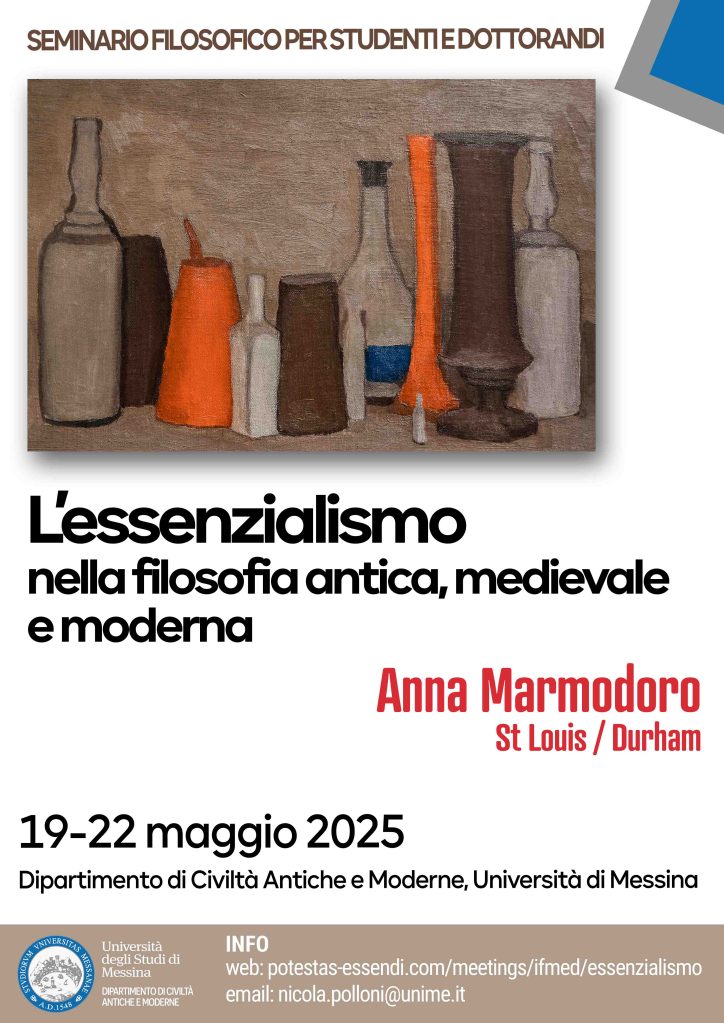
Seminario filosofico tenuto da Anna Marmodoro (St Louis / Durham). Messina, 19-22 maggio 2025
Nessuna cosa può essere un’altra. Questa è l’eredità filosofica più significativa che Parmenide ci ha lasciato. L’implicazione della sua posizione non è semplicemente che una cosa non può diventare un’altra, cambiando, ma anche, e più radicalmente, che una cosa non può essere qualcosa di diverso da se stessa. Una delle conseguenze piú radicali di questa posizione, così come è stata tradizionalmente intesa, è la negazione della possibilità di dire che “x è F”. Tuttavia,la posizione di Parmenide non è assurda. Piuttosto, ci sfida a elaborare una teoria degli oggetti e delle loro proprietà che dal un lato rispetti il principio di Parmenide, secondo cui nessuna cosa può essere un’altra, e che dall’altro sia in grado di spiegare in modo significativo la pluralità, la complessità e il cambiamento di ciò che esiste, permettendoci di fare affermazioni predicative su ciò che è.
In questo ciclo di lezioni, in stile seminario, Anna Marmodoro sostiene che la posizione di Parmenide è alle radici del così detto Essenzialismo Parmenideo (PE), ossia la posizione secondo cui una cosa è ciò che è, o, in un linguaggio più semplice (ma successivo), che una cosa è la sua essenza. Se una cosa è un tutt’uno con ciò che la fa essere ciò che è, poiché non c’è nient’altro che la cosa stessa che la fa essere ciò che è, a maggior ragione non c’è una relazione tra una cosa e la sua essenza. Questo è un punto di contrasto significativo tra l’essenzialismo antico e quello contemporaneo, nonché con l’interpretazione moderna dell’essenzialismo di Aristotele, secondo cui gli oggetti hanno le loro proprietà essenziali, che non possono non avere, perché sono proprio queste proprietà essenziali a rendere ciascuno oggetto ciò che è.
Marmodoro introdurrà i partecipanti all’Essenzialismo Parmenideo e mostrerà come esso sia stato sviluppato da Platone e Aristotele, aprendo la strada alle successive versioni medievali.
Date e orari
Il seminario si svolgerà in forma intensiva dal 19 al 22 maggio 2025 presso l’Aula K del Dipartimento di Civiltà Antiche e Moderne dell’Università di Messina. Gli orari sono i seguenti:
– lunedì 19 maggio 2025, dalle 14.30 alle 17.30 (Aula K, secondo piano)
– martedì 20 maggio 2025, dalle 10.30 alle 12.30 (Aula K, secondo piano)
– mercoledì 21 maggio 2025, dalle 14.30 alle 18.00 (Aula K, secondo piano)
– giovedì 22 maggio 2025, dalle 14.30 alle 18.00 (Aula K, secondo piano)
Gli studenti dell’Università di Messina che partecipano al seminario potranno richiedere il riconoscimento di 2 CFU per la loro partecipazione.
Partecipazione
Il seminario è gratuito e aperto a tutti gli studenti interessati al tema dell’essenzialismo. Sebbene non siano previsti supporti economici per studenti di altre università, l’organizzatore è disponibile a fornire assistenza logistica (informazioni su alloggi, spostamenti, e simili) ai partecipanti provenienti da fuori Messina.
Per ulteriori informazioni, contattare Nicola Polloni al seguente indirizzo email: nicola.polloni@unime.it. Inoltre, da questa pagina è possibile scaricare una guida pratica e logistica alla città di Messina, appositamente realizzata per visitatori accademici.
ENGLISH VERSION
No thing can be another. This is Parmenides’ most significant philosophical legacy to us. The implication of his stance is not merely that a thing cannot become another, by changing, but also and more radically, that a thing cannot be something other than itself. This thought can be otherwise expressed by saying that to be is to be one, meaning that a thing is one with what makes it to be what it is, for there is nothing other than the thing itself that makes it be what is. One of the momentous consequences of this stance, as it has been traditionally understood, is the denial of the possibility of predication (that ‘x is F’) – the keystone upon which speech and thought rest. Yet, Parmenides’ stance makes eminent sense; there is nothing absurd about it. Rather, it challenges us to work out a theory of things that respects Parmenides’ dictum, that no thing can be another, and yet, that can meaningfully explain the plurality, complexity and change of what there is, allowing us to make predicative claims about it.
In this lecture series, seminar-style, Anna Marmodoro argues that Parmenides’ stance is at the roots of what she calls Parmenidean Essentialism (PE), namely the position that a thing is what it is to be it, or, in simpler (but subsequent) language, that a thing is its essence. If a thing is one with what makes it to be what it is, for there is nothing other than the thing itself that makes it be what is, a fortiori there is no thing-making relation that connects a thing to what it is to be it, because there is no divide between them. This is a significant point of contrast between ancient and contemporary essentialism, as well as with the modern interpretation of Aristotle’s essentialism, according to which objects have their essential properties, which they could not lack, because it is precisely these essential properties that make each object what it is.
Marmodoro will introduce the participants to PE and show how it was developed by Plato and Aristotle, opening the way to later medieval versions of it.
Dates and Time
The seminar will be held in an intensive format from 19 to 22 May 2025 in Room K of the Department of Ancient and Modern Civilisations at the University of Messina. The schedule is as follows:
– Monday, 19 May 2025, from 14:30 to 17:30 (Room K, second floor)
– Tuesday, 20 May 2025, from 10:30 to 12:30 (Room K, second floor)
– Wednesday, 21 May 2025, from 14:30 to 18:00 (Room K, second floor)
– Thursday, 22 May 2025, from 14:30 to 18:00 (Room K, second floor)
Students of the University of Messina attending the seminar may request recognition of 2 ESTC for their participation.
Attendance
The seminar is free of charge and open to all students interested in the topic of essentialism. While no financial support is available for students from other universities, the organiser is available to provide logistical assistance (information on accommodation, transport, and similar matters) to participants coming from outside Messina.
For further information, please contact Nicola Polloni at the following email address: nicola.polloni@unime.it. Additionally, a practical and logistical guide to the city of Messina, specifically designed for academic visitors, can be downloaded from this page.
©️Nicola Polloni | Latest update: May 2025
 Potestas essendi